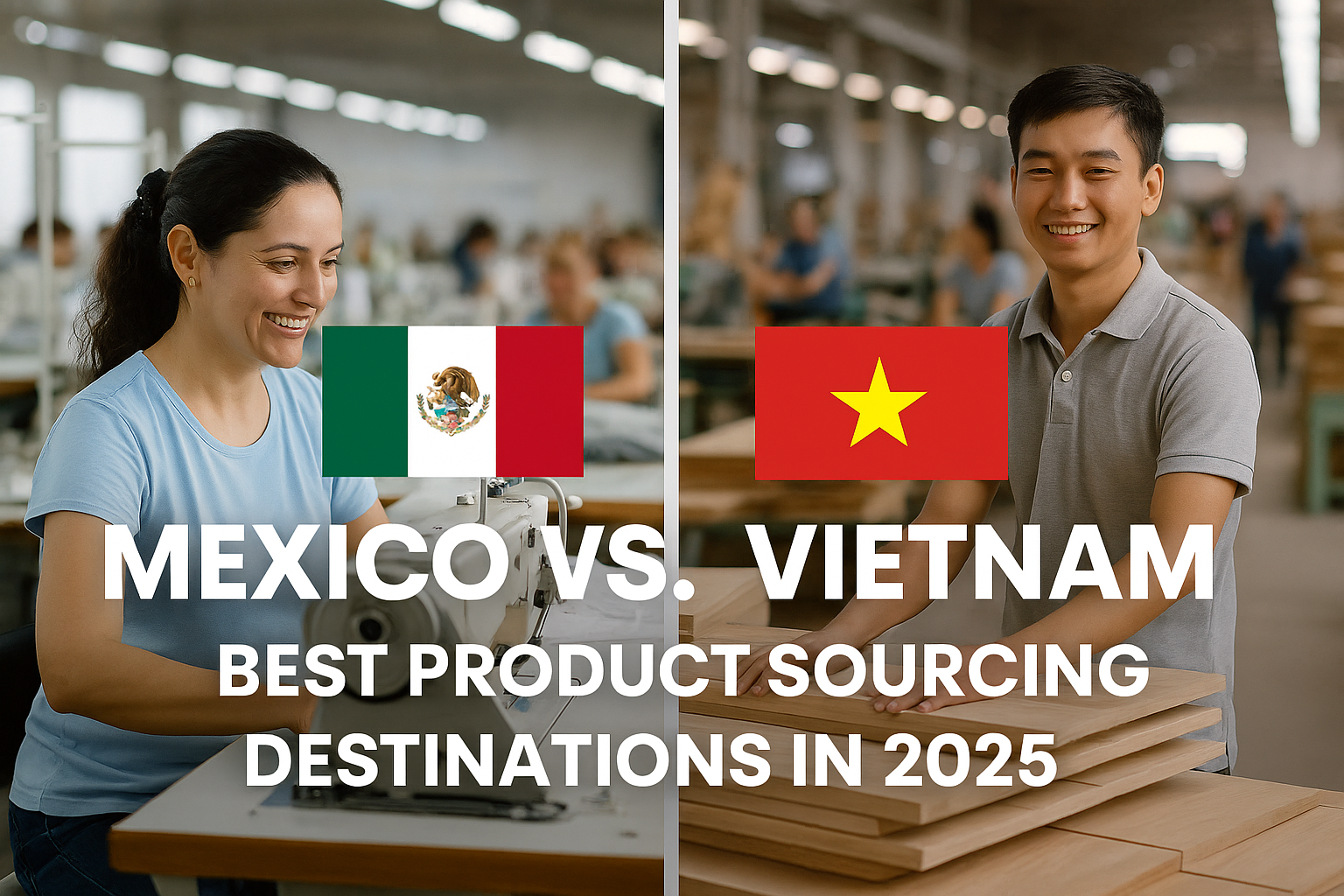
China vs. Vietnam vs. Mexico: Choosing the Right Sourcing Region for Supply Chain Diversification
Introduction: The New Global Sourcing Landscape
The global supply chain is undergoing a profound transformation. For decades, manufacturing in China was the default choice for global sourcing, offering unparalleled scale and a mature ecosystem. However, rising labor costs, geopolitical tensions, and the push for supply chain resilience have driven companies to seek supply chain diversification [1]. The two most prominent alternatives emerging are Vietnam and Mexico, each presenting a unique value proposition for international trade and global sourcing.
Choosing the right region is a complex, strategic decision that goes beyond simple unit cost. It requires a deep dive into logistics, trade agreements, infrastructure, and risk. This post provides a comparative analysis of these three manufacturing powerhouses to help Dunrite Global clients make an informed decision on their next sourcing strategy.
China: The Established Giant
Despite the shift, China remains a dominant force. Its strengths are rooted in its massive scale and decades of investment:
- Unmatched Infrastructure and Ecosystem: China possesses a vast, integrated network of suppliers, specialized clusters, and world-class ports, making it ideal for complex, high-volume production.
- Skilled Labor and Scale: The sheer size of its workforce and the depth of its engineering and technical talent pool are difficult to replicate.
- Speed to Market: The mature supply chain allows for rapid prototyping and production ramp-up.
However, the challenges are significant:
- Rising Costs: Labor and operational costs have increased substantially, eroding the cost advantage.
- Geopolitical and Trade Risk: Tariffs and trade disputes create uncertainty and increase the total landed cost of goods.
- Long Lead Times: The distance to Western markets still necessitates long ocean freight times.
Vietnam: The Rising Star of Southeast Asia
Vietnam has rapidly become the leading alternative for sourcing in Asia, particularly for light manufacturing, textiles, and electronics. Its appeal is largely driven by cost and favorable trade policies:
- Competitive Labor Costs: Vietnam offers significantly lower labor costs than China, making it attractive for labor-intensive goods.
- Favorable Trade Agreements: Participation in agreements like the Comprehensive and Progressive Agreement for Trans-Pacific Partnership (CPTPP) and the EU-Vietnam Free Trade Agreement (EVFTA) provides preferential access to major markets.
- Government Support: The government is actively investing in infrastructure and promoting foreign direct investment (FDI).
The main limitations include:
- Infrastructure Bottlenecks: While improving, port capacity and road networks can be strained, leading to logistics delays.
- Limited Supply Chain Depth: The country still relies on importing many raw materials and components, often from China, which can negate some diversification benefits.
- Smaller Scale: Vietnam cannot yet match China's capacity for extremely high-volume or complex production.
Mexico: The Nearshoring Advantage
Mexico’s primary draw is its proximity to the massive North American market, a concept known as nearshoring Mexico. This advantage is particularly strong for high-value, time-sensitive goods:
- Geographic Proximity: Shared borders with the U.S. allow for fast, flexible, and cost-effective land transport, drastically reducing lead times and improving inventory management.
- USMCA Benefits: The United States-Mexico-Canada Agreement (USMCA) provides duty-free access to the U.S. and Canadian markets, a massive advantage over sourcing from Asia.
- Skilled Manufacturing Base: Mexico has a strong, established base in automotive, aerospace, and electronics manufacturing, offering a high level of technical expertise.
Challenges for Mexico include:
- Higher Labor Costs: While lower than the U.S., labor costs are generally higher than in Vietnam and some parts of China.
- Security and Logistics: Concerns over security and border crossing efficiency can add complexity to the supply chain.
- Regional Concentration: Manufacturing is heavily concentrated in certain border regions, which can lead to localized cost inflation and competition for resources.
Comparative Sourcing Analysis
The following table summarizes the key factors for choosing between these three global sourcing regions:
| Factor | China | Vietnam | Mexico |
|---|---|---|---|
| Primary Advantage | Scale, Mature Ecosystem | Low Labor Cost, Trade Pacts | Nearshoring, USMCA Access |
| Labor Cost | High (and rising) | Low | Medium (Higher than Vietnam) |
| Supply Chain Depth | Very High | Medium (Dependent on imports) | High (Strong in specific sectors) |
| Lead Time to US/EU | Long (Ocean Freight) | Long (Ocean Freight) | Short (Land/Air Freight) |
| Trade Agreement Access | Complex (Tariffs) | Excellent (CPTPP, EVFTA) | Excellent (USMCA) |
| Geopolitical Risk | High | Medium | Medium |
| Best For | High-volume, complex goods | Labor-intensive, light manufacturing | High-value, time-sensitive goods (Nearshoring) |
Conclusion: A Strategic Decision for the Future
The decision of where to source is no longer a binary choice. It is a strategic exercise in risk management and supply chain diversification.
- China remains essential for companies requiring massive scale and a deep, specialized supply chain.
- Vietnam is the clear winner for companies seeking lower labor costs and preferential access to European and Asian markets.
- Mexico is the optimal choice for nearshoring to the North American market, prioritizing speed, flexibility, and USMCA benefits.
Dunrite Global advises clients to adopt a "China Plus One" or "China Plus Two" strategy, leveraging the unique strengths of each region to build a resilient and cost-effective global supply chain. The future of international trade is diversified, and understanding the nuances of these three regions is the first step toward securing a competitive advantage.
References
- SourceOne Ltd. (2025). Vietnam vs. Mexico: Which Alternative Sourcing Destination Offers Better Long-Term Value Beyond China? Link
- SV Global Ltd. (2025). A Comparative Analysis of Manufacturing in Mexico vs China. Link
- Vietnam Briefing. (2024). Vietnam vs. China Manufacturing: Cost, Quality, and Infrastructure Comparison. Link
- E-BI. (2025). China vs. Mexico Manufacturing: A Cost and Quality Comparison. Link
- Dragonsourcing. (2025). International Sourcing Trends 2025: Key Changes in Global Trade. Link